
Advent Devotional 2025
Wednesday, December 24
Scripture: Luke 2:1-20 KJV
[1] And it came to pass in those days, that there went out a decree from Caesar
Augustus that all the world should be taxed.
[2] (And this taxing was first made when Cyrenius was governor of Syria.)
[3] And all went to be taxed, every one into his own city.
[4] And Joseph also went up from Galilee, out of the city of Nazareth, into Judaea, unto
the city of David, which is called Bethlehem; (because he was of the house and lineage
of David:)
[5] To be taxed with Mary his espoused wife, being great with child.
[6] And so it was, that, while they were there, the days were accomplished that she
should be delivered.
[7] And she brought forth her firstborn son, and wrapped him in swaddling clothes, and
laid him in a manger; because there was no room for them in the inn.
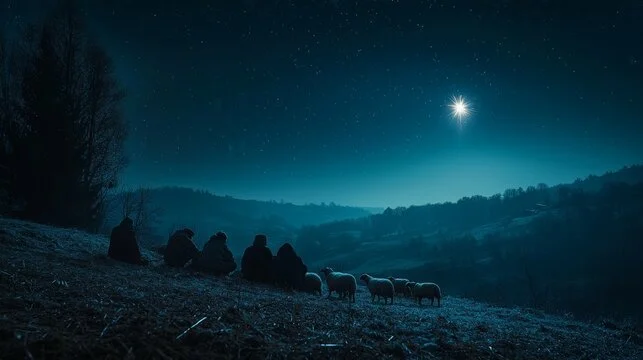
[8] And there were in the same country shepherds abiding in the field, keeping watch
over their flock by night.
[9] And, lo, the angel of the Lord came upon them, and the glory of the Lord shone round
about them: and they were sore afraid.
[10] And the angel said unto them, Fear not: for, behold, I bring you good tidings of great
joy, which shall be to all people.
[11] For unto you is born this day in the city of David a Savior, which is Christ the Lord.
[12] And this shall be a sign unto you; Ye shall find the babe wrapped in swaddling
clothes, lying in a manger.
[13] And suddenly there was with the angel a multitude of the heavenly host praising
God, and saying,
[14] Glory to God in the highest, and on earth peace, good will toward men.
[15] And it came to pass, as the angels were gone away from them into heaven, the
shepherds said one to another, Let us now go even unto Bethlehem, and see this thing
which is come to pass, which the Lord hath made known unto us.
[16] And they came with haste, and found Mary and Joseph, and the babe lying in a
manger.
[17] And when they had seen it, they made known abroad the saying which was told them
concerning this child.
[18] And all they that heard it wondered at those things, which were told them by the
shepherds.
[19] But Mary kept all these things, and pondered them in her heart.
[20] And the shepherds returned, glorifying and praising God for all the things that they
had heard and seen, as it was told unto them.
Some thoughts
And so, we read the story of the birth of Christ again this year. I used the King James Version because that is probably the most memorized version. If you haven’t memorized it, let me encourage you to do so. I want to make a few comments about the context of the passage without destroying your image of what happened. The story has been so romanticized through the years. Mary and Joseph’s ancestors on both sides of their family were of the lineage of King David (c.1000 BC). That means their ancestry had been traced back a thousand years even without Ancestry.com! How do we know? Their genealogy is in the Bible (Matthew 1 Joseph’s and Luke 3 Mary’s). That is important because Jesus was to be born from the line of King David and the tribe of Judah. In passing, it is interesting that a previous king in Joseph’s line had acted toward God in such an egregious manner that God brought judgment on his line declaring that no king would ever come from his line confirming that Joseph could not possibly be the father of Jesus.
It is quite possible that Mary and Joseph had relatives living in Bethlehem since that was the birthplace and home of King David. Most likely Mary and Joseph had made the roughly 90-mile trip from Nazareth to Bethlehem several weeks prior to her delivery. Times were slower back then. Often whole groups of people would travel together for community and for safety. It would have been natural for Mary and Joseph to stay with their extended family. Bethlehem was undoubtedly flooded with people from all over returning to their families of origin.
The use of the word “inn” is an unfortunate translation of the text. “Lodging space” would have been more accurate. There was a Greek word for “inn” and Luke did not use that word here, though he did use it in the story of the good Samaritan. Homes in this era often had living spaces on a second story for the family with space for a few animals on the ground floor. Since the lodging space in the home was apparently full of other family, Mary and Joseph moved to the space where the animals were kept, a humbling way for the King of the Universe, the one He created, to enter this world. I realize these are not particularly inspiring words for a Christmas day! There is a point. With this rather mundane description of the setting pictured in your mind, I’d like you to imagine yourself in the story that night. Tonight, go outside in the dark by yourself, hopefully away from lights if possible. Look up into the sky and visualize thousands upon thousands of angels singing “glory to God in the highest heaven, and peace on earth (and here is that phrase again) to those with whom God is pleased.” Remember the words at the Gabriel’s annunciation to Mary? Let the message soak in. The working of God appears in very ordinary mundane settings for those who see it.
Prayer:
Almighty God, we give Thee thanks for the mighty yearning of the human heart for the coming of a Savior, and the constant promise of Thy Word that He was to come. In our own souls we repeat the humble sighs and panting aspiration of ancient men and ages, and own that our souls are in darkness and infirmity without faith in him who comes to bring God to man and man to God. We bless Thee for the tribute that we can pay to him from our very sense of need and dependence, that our own hearts can so answer from their wilderness, the cry, “Prepare ye the way of the Lord.” In us the rough places are to be made smooth, the crooked straight, the mountains of pride brought low, and the valleys of despondency lifted up. O God, prepare Thou the way in us now, and may we welcome anew Thy Holy Child. Hosanna! Blessed be he who cometh in the name of the Lord. Amen. —Samuel Osgood, 1862 Prayers Ancient and Modern, p.360

Tuesday, December 23
Scripture: Titus 2:11-15
[11] For the grace of God has been revealed, bringing salvation to all people. [12] And we
are instructed to turn from godless living and sinful pleasures. We should live in this evil
world with wisdom, righteousness, and devotion to God, [13] while we look forward with
hope to that wonderful day when the glory of our great God and Savior, Jesus Christ,
will be revealed. [14] He gave his life to free us from every kind of sin, to cleanse us, and
to make us his very own people, totally committed to doing good deeds.
[15] You must teach these things and encourage the believers to do them. You have the
authority to correct them when necessary, so don’t let anyone disregard what you say.
Some thoughts
Some background will help grasp some of the dynamics of this passage. Here we have another of Paul’s letters to fledgling churches. This one is to Titus, a “son in the faith.” Titus’ calling is to serve on the island of Crete, off the coast of Greece. The culture of the Cretans was vulgar and crude, known particularly for lying and moral corruption. They were also great lovers of money and greedy in nature, not a pleasant people! Into this world came the gospel! In the portion of this letter, Paul gives guidance for how a believer should live in the midst of this kind of world. I believe, through the apostle, God gives us direction as to how we might live in today’s world, much like the lifestyle of the Cretans. The beginning words start with the grace of God extending to all people. God is a ways the initiator of grace. What is very clear is that we are not to separate ourselves from this world. His exact words were, “live in this evil world with wisdom, righteousness, and devotion to God, while we look forward with hope to that wonderful day…” What a contrast to the mindset of the world today!
Wisdom, righteousness, and devotion to God – what a beautiful and attractive way to live. In the Christmas season with Santas, newest gotta-have toys, gadgets to fill our gift lists, new Christmas songs, winter-solstice celebrations, winter concerts, parties, newly released movies, college bowl games (GO SOONERS!), etc. – we have every possible thing to fill the mind with anything but the significance of the birth of the Savior of the world. The good news is we have the opportunity to encourage those around us in the truth. The Cretans thrived on lies and corruption of all kinds. In the midst of such, churches grew and ministered among that society, and lives were transformed. We’ve been given that same opportunity in our world these days of Advent. Perhaps you’ll have an opportunity today to express devotion to God and help point a “Cretan” to the Savior.
Prayer:
O God of truth and wisdom, I praise Thee for the revelation of Thyself in the gospel, for Thy heart as a dwelling place of pity, for Thy thoughts of peace toward me, for Thy patience and Thy graciousness, for the vastness of Thy mercy. Thou hast moved my conscience to know how the guilty can be pardoned, the unholy sanctified, the poor enriched. My I cherish simplicity and godly sincerity of character. Help me to be before Thee as in appearance I am before men, to be religious before I profess religion, to leave the world before I enter the church, to set my affections on things above, to shun forbidden follies and vanities, to be a dispenser as well as a partaker of grace, to be prepared to bear evil as well as to do good. O God, make me worthy of this calling, that the name of Jesus may be glorified in me and I in Him as I live in the very fallen, broken, and confused world. Amen. (The Valley of Vision, 12, adapted)
Monday, December 22
Scripture: Colossians 1:15-20
[15] Christ is the visible image of the invisible God.
He existed before anything was created and is supreme over all creation,[a]
[16] for through him God created everything
in the heavenly realms and on earth.
He made the things we can see
and the things we can’t see—
such as thrones, kingdoms, rulers, and authorities in the unseen world.
Everything was created through him and for him.
[17] He existed before anything else,
and he holds all creation together.
[18] Christ is also the head of the church,
which is his body.
He is the beginning,
supreme over all who rise from the dead.[b]
So he is first in everything.
[19] For God in all his fullness
was pleased to live in Christ,
[20] and through him God reconciled
everything to himself.
He made peace with everything in heaven and on earth
by means of Christ’s blood on the cross.
Some thoughts
The passage you just read is one of the most complete and profound summaries of understanding who Jesus is in all Scripture. Many of the early Christian debates as to the identity of Christ focused on this passage. Pair this Colossians passage with the Annunciation we spoke of yesterday, and you have quite a discussion! Jesus is the invisible God made visible in human flesh. How often has that happened? Once. God determined that this was the best way to solve our sin-separation problem. Give the people God in human flesh whom they could see, hear, and touch. As the second member of the Trinity, the Son has never not existed. We have trouble grasping that truth. Put another way, He existed when nothing else did. He is God’s agent of creation in all realms of the heavens as well as the earth. For example, He knows every square inch of the universe – if you even measure it that way and understands everything about it. Everything was created through Him and for Him. He understands how it was made and what its purpose is. He is the creator of matter. He is also the one who holds all creation together. His holding things together is more significant than gravity, which he invented. Such a lofty Being is beyond human ability to comprehend or even relate to. God is the only uncreated Being to exist.
So, the Incarnation of the Son was God’s solution. The Son took on human flesh as a fully human God-man. God in human form was someone to whom human beings could relate. Jesus walked on this earth and interacted with people. The other miraculoustruth is that Jesus is alive forever and relates to people today.
It is through the incarnate Son that God is reconciling everything to Himself. How does this happen? The concluding sentence of this passage answers that question very clearly – by the shed blood of Christ on the cross.
(I am indebted to Carl Gallups’ book Gods of the Final Kingdom for some of the following insights.) The eternal second member of the Trinity, Jesus, was born as a human being and appeared in human form (Philippians 2:7). All human beings have a sin nature; Jesus does not. A phrase associated with the Savior is the “only begotten Son of God” (John 3:16). That phrase means “one of a kind,” mongenés in Greek. Only begotten means “there are no other humans like this person.”
We move next to Gabriel’s visit to Mary. Words are so important. His words were “TheHoly Spirit will come on you, and the power of the Most High will overshadow you. So the holy one to be born will be called the Son of God” (Luke 1:35). The Holy Spirit in overshadowing Mary, would generate within her womb the conception of Jesus miraculously. This was not a normal sperm-and-egg pregnancy. The wording here is the very same concept expressed in Genesis 1:2. The Spirit was hovering over (overshadowing) the face of the waters. God spoke creation into being. God’s overshadowing power brought the Son into the form of a human. This doe not mean that the Son had not previously existed. Remember what you just read in Colossians. He had not previously existed in the form of a human.
Simply by His Word, God created and placed this human embryo in the womb of Mary, a one-of-a-kind miracle. You may recall that an unborn baby’s blood is separate from its mother’s. Its DNA is different. Its life is totally separate from the mother’s. Neither Joseph’s nor Mary’s blood was involved in the creation of the embryo that was Jesus. So, there is none of the “fallen nature” of humans being passed into the embryo. While nutrition passes from the mother to the baby through the placenta, the circulatory systems are entirely separate. The carbon dioxide and waste from the baby are passed back through the placenta and disposed of in the mother’s system. In summary, the blood, DNA, and the body of the baby are entirely and uniquely different from the mother’s. The Spirit of God, divinity, and the “seed of the woman,” humanity, produced the holy, sinless offspring of May, the incarnate Son of God, the Savior of the world. One additional observation. The blood of Christ shed on the cross was holy and pure, the blood of this sinless Redeemer. The Father could accept the blood of His Son as atonement for our sin because it was God’s own blood, the perfect sacrifice. Notice reconciliation comes through shed blood, as this passage of Colossians concludes. Therefore, it never needs to be repeated. Another implication of the significance and importance of recognizing the divine conception of Jesus, is that the birth of the babe in the manger is deceptive in its simplicity and overwhelmingly profound and transformational in its Christology.
Prayer:
O God, who has proven Thy love for mankind by sending us Jesus Christ our Lord, and hast illumined our human life by the radiance of His presence, I give Thee thank for this Thy greatest gift. For His willingness to take the form a human:
For His willingness to leave the glories of heaven:
For His great love for a broken and fallen creation:
For my Lord’s days upon earth:
For the wonder of the Incarnation:
For His obedience unto death:
For His triumph over death:
For the presence of His Spirit with me now:
I thank thee O God.
Father of our Lord Jesus Christ, I commit all by ways unto Thee. May this day be for me a day to reflect my love to the Savior. May all my walk and conversation be such as becometh the gospel of Christ. Amen (A Diary of Private Prayer, 29, adapted)

Fourth Sunday in Advent, December 21
Scripture: Isaiah 7:13-14
[13] Then Isaiah said, “Listen well, you royal family of David! Isn’t it enough to exhaust
human patience? Must you exhaust the patience of my God as well? [14] All right then,
the Lord himself will give you the sign. Look! The virgin will conceive a child! She will
give birth to a son and will call him Immanuel (which means ‘God is with us’).
Luke 1:26-31
[26] In the sixth month of Elizabeth’s pregnancy, God sent the angel Gabriel to Nazareth,
a village in Galilee, [27] to a virgin named Mary. She was engaged to be married to a man
named Joseph, a descendant of King David. [28] Gabriel appeared to her and said,
“Greetings, favored woman! The Lord is with you!”
[29] Confused and disturbed, Mary tried to think what the angel could mean. [30] “Don’t be
afraid, Mary,” the angel told her, “for you have found favor with God! [31] You will
conceive and give birth to a son, and you will name him Jesus.
Some thoughts:
This passage from Isaiah is perhaps one of the best-known prophetic texts in the Old Testament. The context is this: Israel was fearful of an attack from Damascus, the capital of Syria (some things never change.) Through Isaiah, God sent a message to the king of Judah with the encouraging words that the kings he feared would be deserted and that God would be with Judah both in presence and protection. Once again, while this prophecy had immediate meaning for Israel’s history (Hezekiah was a godly king born about this time), it also spoke prophetically of the birth of the Messiah.
Note also the mention of the royal family of David in both passages. As we have said so many times, note the significance of every phrase. Then there is the phrase “God sent the angel to Nazareth, a village in Galilee.” It was prophesied that the Messiah would be a Nazarene. The childhood home of Jesus was also declared long before His birth. What is interesting here is that on several occasions, women who were barren were visited by an angel to announce they would become pregnant and bear a son, a divine intervention on their behalf: an angel appeared to Sarah (Isaac), an angel spoke to Manoah’s wife (Samson), and the angel Gabriel to Zachariah via Elizabeth (John the Baptist), Hannah –though not via an angel, but prophesied by Eli (Samuel), and Gabriel to Mary (Jesus). Every single one of those five boys played a significant role in God’s greater story of redemption culminating in Jesus’ birth. All are mentioned as heroes of the faith in Hebrews chapter eleven. Their mothers were great women who put their trust in God in improbable situations and God honored their faith in a most powerful way. Though you may not be visited by an angel today, (there’s always a chance), may you exhibit the same trust in God as these women as your life unfolds. When the message came, they trusted the Word, though none were pregnant at the moment they were told. Nothing was different. They simply believed God’s Word then things changed.
Prayer:
Lord Jesus, the Author and Giver of all life, we realize You visited these ordinary women in a very unique way in granting them the gift of becoming mothers to some very unique boys. They trusted You, against all odds. For we realize Lord, that with You there is no such thing as “odds.” You are sovereign in the lives of Your children. You clearly leave nothing to “chance” because it doesn’t exist in your world. Forgive us when we lack faith in You and in Your sovereign will. Sometimes you bless barren women with children and sometimes You bless them in remaining barren. In either circumstance, what you ask of us is faith in You and Your wisdom. Lord Jesus, we give You our trust this day. In the name of Jesus we pray, Amen.

Saturday, December 20
Scripture: John 7:40-52
[40] When the crowds heard him say this, some of them declared, “Surely this man is the
Prophet we’ve been expecting.” [41] Others said, “He is the Messiah.” Still others said,
“But he can’t be! Will the Messiah come from Galilee? [42] For the Scriptures clearly state
that the Messiah will be born of the royal line of David, in Bethlehem, the village where
King David was born.” [43] So the crowd was divided about him. [44] Some even wanted
him arrested, but no one laid a hand on him.
[45] When the Temple guards returned without having arrested Jesus, the leading priests
and Pharisees demanded, “Why didn’t you bring him in?”
[46] “We have never heard anyone speak like this!” the guards responded.
[47] “Have you been led astray, too?” the Pharisees mocked. [48] “Is there a single one of us
rulers or Pharisees who believes in him? [49] This foolish crowd follows him, but they are
ignorant of the law. God’s curse is on them!”
[50] Then Nicodemus, the leader who had met with Jesus earlier, spoke up. [51] “Is it legal
to convict a man before he is given a hearing?” he asked.
[52] They replied, “Are you from Galilee, too? Search the Scriptures and see for yourself —
no prophet ever comes from Galilee!”
Some thoughts
In this portion of Scripture, Jesus is interacting with the people and the religious leaders. It’s essential to know the context and something of the Jewish festivals to gain a fuller understanding of the undertones of the interaction. This entire setting takes place during one of three major Jewish Feasts, the Feast of Tabernacles, which occur sin the early fall. It is one of the pilgrimage festivals, so there will be Jewish people from near and far countries. It is important to understand that a “Festival or Feast” is a type, a rehearsal for a later, greater celebration in which the Messiah will lead to the ultimate consummation of the celebration, a Feast yet to occur! In each of the chapters of his gospel, John makes a single point identifying Jesus as Messiah and God’s Son. Each chapter reveals another aspect of Jesus’ authority.
Now let’s look at the festival itself. During this seven-day celebration, water was taken in pitchers from the Pool of Siloam and carried in a joyous procession to the Temple each day. Prayers were said asking God to send rain in the winter season to ensure a good harvest. The eighth day was the “Great Celebration” and the culmination of the whole feast. Gold and silver pitchers were used. Water was poured over the altar as the Levites sang joyously. It is at this point, with hundreds of people from everywhere crowding around the altar, that Jesus stood and shouted these words, “Anyone who is thirsty may come to me! Anyone who believes in me may come and drink! For the Scriptures declare, ‘Rivers of living water will flow from his heart.’” (John 7:38)
Usually, rabbis were seated when they taught. Several places in the Old Testament make the same declaration. Remember, the Jews were familiar with their Scripture and recognized the implications of what Jesus had just said. How do we know? Their following words were quoting Moses’ reference to the coming of a [super] Prophet in the book of Deuteronomy (chapter 18). Other people said He was the Messiah. They knew Jesus’ hometown was Nazareth and assumed He was born there. They also knew the Messiah would come from Bethlehem. I’m kind of curious why no one asked him, “Jesus, where were You born?” They also missed the connection that the Messiah would be a Nazarene (one from the town of Nazareth (Judges 13:5, Isaiah 9:1-2, and Matthew 2:23). The people were divided as to the identity of Jesus, like today. The Temple guards, though, were taken aback by Jesus’ comments. Jesus was the living water (Woman at the well, John 4). But in this case, He was speaking of the future pouring out of the Holy Spirit at Pentecost (fifty days after His resurrection).
As often happens, weak leaders will ridicule crowds that don’t agree and then speak confidently in crowds that embrace their own viewpoints. However, the leaders misread the situation. Nicodemus, who had a one-on-one encounter with Jesus earlier (John 3), spoke wisely, as his advice was to listen to what Jesus had to say. The next time we hear of Nicodemus was when he was one of the two men who put Jesus in the tomb after the crucifixion. He apparently came to faith. One of the things that strikes me most in this passage is the phrase, “We never heard anyone speak like this!” The message of the gospel is unlike any cultural narration going on today. It was revolutionary then, and it is revolutionary today. Look for a chance to share the “good news” today. The people around us are thirsty for the authentic life-giving water.
Prayer:
Eternal Light, before whom all darkness is light, and in comparison with whom, every other light is but darkness, may it please Thee to send forth Thy light and Thy truth, that they may lead us. Purify, we pray Thee, our souls from all impure imaginations, that Thy most beautiful and holy image may be again renewed within us. Till this most blessed day break, and shadows fly away, let Thy Spirit be continually with us, and my we feel the powerful effects of Thy Divine grace constantly directing and supporting our steps; that all our endeavors, throughout the whole remaining in part of our lives, may serve to promote the honor of Thy blessed Name, through Jesus Christ our Lord. Amen.–Robert Leighton 1611-1684, Prayers Ancient and Modern

Friday, December 19
Scripture: Hebrews 1:5-14
[5] For God never said to any angel what he said to Jesus:
“You are my Son.
Today I have become your Father.”
God also said,
“I will be his Father,
and he will be my Son.”
[6] And when he brought his supreme Son into the world, God said,
“Let all of God’s angels worship him.”
[7] Regarding the angels, he says,
“He sends his angels like the winds,
his servants like flames of fire.”
[8] But to the Son he says,
“Your throne, O God, endures forever and ever.
You rule with a scepter of justice.
[9] You love justice and hate evil.
Therefore, O God, your God has anointed you,
pouring out the oil of joy on you more than on anyone else.”
[10] He also says to the Son,
“In the beginning, Lord, you laid the foundation of the earth
and made the heavens with your hands.
[11] They will perish, but you remain forever.
They will wear out like old clothing.
[12] You will fold them up like a cloak
and discard them like old clothing.
But you are always the same;
you will live forever.”
[13] And God never said to any of the angels,
“Sit in the place of honor at my right hand
until I humble your enemies,
making them a footstool under your feet.”
[14] Therefore, angels are only servants—spirits sent to care for people who will inherit
salvation.
Some thoughts
Once again, the richness of this passage is too much! The unidentified author of Hebrews wrote to the Jewish community who had become believers and were trying to understand their Jewish faith in relation to Jesus. The writer begins with establishing the preeminence and superiority of Jesus over every being, those seen and unseen starting with the angels. In the Jewish mind, angels were the most exalted beings for their role in God’s revelations to His people throughout the Old Testament, though they were not worshiped. In verse five the writer contrasts Jesus’ position with the Father to that of the angels. Jesus is His Son; the angels are not.
It is important to note that Jesus did not become the Son at the exaltation for He was involved at the creation. The Son has always existed, though not always in human flesh—until the Incarnate birth. Virtually every verse in this Hebrews passage is a direct quote from some portion of the Old Testament. The author is putting together this argument on helping the Jews understand the position of Jesus in relation to the First Testament, by showing how Jesus is actually present in these Old Testament passages, that is, the passages are talking about the Son. The fact that Moses said, “Let all of God’s angels worship him” carried great weight with the Jewish community for Moses was the greatest of the Old Testament characters (Deut 32:43). He was the one who talked with God directly and received the Law. In addition, the Father asked His Son to sit at His right hand, a position reserved for the Son of God alone.
In the rest of the book, the writer goes on to show Jesus as superior to Moses (Prophets), superior to the priesthood, and His ministry superior to the old covenant. In every way, Jesus is the preeminent Prophet, Priest, and King. As we have said before, do not be shortsighted in thinking Christmas is simply about the birth of a special baby born in Bethlehem. Hebrews gives us a bigger picture. The nativity is not a birthday party for Jesus. The Son of God has no birthday since He has always existed. Please put the manger in context and try to grasp the impossible. The Creator of all that is seen and unseen, all that has existed or ever will exist, One who has never not existed and will never die, has condescended [that word is so inadequate] as the Son of God, to take on human flesh and be born in a manger into a sinful world to bring a costly redemption to that world out of love for people, many of whom reject His love. But because of this incomprehensible expression of love, He makes it possible for the whole created order to be redeemed and live in fellowship with God forever. No, it’s not about a birthday party. It’s about doing away with birthdays forever as His children live in God’s presence throughout eternity as a result of the superiority of the Savior.
Prayer:
Thou Great I AM, fill my mind with elevation and grandeur at the thought of a Being with whom one day is as a thousand years, and a thousand years as one day, a mighty God who, amidst the lapse of worlds, and the revolutions of empires, feels no variableness, but is glorious in immortality. May I rejoice that, while men die, the Lord lives; that, while all creatures are broken reeds, empty cisterns, fading flowers, withering grass, He is the rock of ages, the fountain of living waters. Turn my heart from vanity, from dissatisfactions, from uncertainties of the present state to an eternal interest in Christ. Let me remember that life is short and unforeseen and is only anopportunity for usefulness; give me a holy avarice to redeem the time, to awake at every call to charity and piety, so that I may feed the hungry, clothe the naked, instruct the ignorant, reclaim the vicious, forgive the offender, diffuse the gospel, show neighborly love to all. Let me live a life of self-distrust, dependence on thyself, mortification, crucifixion, prayer. — From The Valley of Vision, p.104

Thursday, December 18
Scripture: Hebrews 1:1-4
[1] Long ago God spoke many times and in many ways to our ancestors through the
prophets. [2] And now in these final days, he has spoken to us through his Son. God
promised everything to the Son as an inheritance, and through the Son he created the
universe. [3] The Son radiates God’s own glory and expresses the very character of God,
and he sustains everything by the mighty power of his command. When he had
cleansed us from our sins, he sat down in the place of honor at the right hand of the
majestic God in heaven. [4] This shows that the Son is far greater than the angels, just as
the name God gave him is greater than their names.
Some thoughts
There is so much packed into these four verses, we’ll have to make only a few observations. [These four verses are actually one sentence in Greek.] The whole passage is an expansion of the third and fourth words, “God spoke.” Unlike any other deity, our God speaks to humans. Buddha is silent. Mohammed is silent. Allah is silent. Remember how Genesis begins? In the beginning, God created. And God said. God sustains everything simply by the power of His Word, then and now. God is a living, uncreated spiritual Being in the person of Father, Son, and Holy Spirit, one God. He is not an idea, a force, a higher power, or a concept. He speaks creatively as we are reminded in the third verse of the Bible. In the Old Testament , He spoke through dreams, visions, mighty acts, stories, commands, angelic appearances, a donkey, and even appearances of God Himself (theophany). The prophets were His messengers speaking the words of God to the people.
The writer of Hebrews then brings things current in stating “and now in these final days,” referring more to the time of the writing of Hebrews, God has spoken to us through His Son. Can you think of a better way to communicate with people except to become one of them? What would be the best way to communicate with a dog? Become a dog yourself. God condescended from the glories of heaven as the Son took on human flesh. We then learn a little more about the Son and consequently about the character of God. Put simply, the universe was created through the Son.
The late Stephen Hawking commented the universe created itself and could not have been created by a god because there was no time for a god to exist because there was no time before the Big Bang. There is a fatal flaw in his conclusions. The God of the Bible exists outside of time altogether. An eternal God, the God who was, and is, and is to come, is not bound by chronos, measured time. Here we read He works in time while remaining outside of it.
Two words are used in this section that are used nowhere else in the New Testament. The words are “radiates” and “expresses.” The former includes the idea of an intense brightness, reminding us of the Transfiguration account. It is the brightness of God’s own glory, the manifestation of His presence. The source of this radiant brightness is in Jesus Himself. His glory expresses God’s glory, as they are one in the same, the very character of God, further affirmation of the deity of Christ. There is so much more here, but we need to stop. A simple point is, in the birth of the Divine Baby in Bethlehem, God spoke to all people and to all of creation, “I have come to make all things new.” How we long for the subsequent advent of the Savior, when we will experience the fulfillment of God’s plan of restoration of the whole created order. That will be a Word and a brilliance, no one will miss.
Prayer:
When I think of all this, I fall to my knees and pray to the Father, the Creator of everything in heaven and on earth. I pray that from His glorious, unlimited resources, He will empower you with inner strength through His Spirit. Then Christ will make His home in your hearts as you trust in him. Your roots will grow down into God’s love and keep you strong. And may you have the power to understand, as all God’s people should, how wide, how long, how high, and how deep His love is. May you experience the love of Christ, though it is too great to understand fully. Then you will be made complete with all the fullness of life and power that comes from God. —The Apostle Paul (Ephesians 3:14-19)

Wednesday, December 17
Scripture: Mark 9:9-13
[9] As they went back down the mountain, he told them not to tell anyone what they had
seen until the Son of Man had risen from the dead. [10] So they kept it to themselves, but
they often asked each other what he meant by “rising from the dead.”
[11] Then they asked him, “Why do the teachers of religious law insist that Elijah must
return before the Messiah comes?”
[12] Jesus responded, “Elijah is indeed coming first to get everything ready. Yet why do
the Scriptures say that the Son of Man must suffer greatly and be treated with utter
contempt? [13] But I tell you, Elijah has already come, and they chose to abuse him, just
as the Scriptures predicted.”
Some thoughts
The context for what you just read is helpful in gaining insight into the Scripture. Jesus, Peter, and the brothers James and John had been together on the Mount of Transfiguration. The three disciples had just encountered a most amazing sight. They were present in a meeting between Jesus, Moses-who had died 1400 years earlier, and Elijah-who had died 700 years earlier, and Jesus who had never died! Moses was the receiver of the Law. Elijah was the representative of the prophets. The Scriptures tell us their “meeting” and discussion concerned Jesus’ “exodus.” Moses was very familiar with an “exodus” and Elijah’s “exodus” was in a chariot of fire!
A cloud came down and enveloped all six of them. To make matters even more wondrous, God the Father in heaven spoke audibly and addressed the disciples. Talk about a life changing experience! The cloud lifted and Moses and Elijah were no longer there, only Jesus. What was being said by this action? Jesus was the fulfillment of the Law of Moses. He was the quintessential Prophet, superseding Elijah, the greatest Old Testament prophet. The ministry of Moses and Elijah was finished, hence the visual and the auditory affirmation of the superiority of Jesus from God the Father.
This is the backdrop for the passage you just read. It seems a little strange to us, but Jesus told the three disciples not to tell anyone what they had seen until He had risen from the dead. Why? Something to think about, if the disciples had broadcast what they had seen and heard, the natural conclusion may have been something like this. He is greater than the Law and the Prophets. The Messiah, as a political and mi litary leader, is here to lead an overthrow of the Romans. I don’t know that that is the case, but in having them wait to talk about this encounter until after the resurrection would make it very clear that the overthrow of the occupiers was not His goal or purpose. His “war” was on sin and rebellious hearts in the work of establishing His Kingdom.
The disciples go on to ask another question about the necessity of Elijah preceding the Son of Man, the name Jesus used for Himself. John the Baptist was a “type” of Elijah, both of whom suffered in their missions. They were forerunners of Jesus’ suffering. Jesus reminded them that Elijah had already come and many rejected His message proclaiming the coming of the Lord. One of the things I’m frequently aware of as I read Scripture in describing the blindness of people regarding the working of the Lord, is that I am “those people.” All too often there is a dullness in my spirit that does not see God at work in the world in which I live. Jesus came quietly to Bethlehem, and He comes quietly today. You can talk about now. “He is risen!”
Prayer:
O God, Thou injured, neglected, provoked benefactor, when I think upon thy greatness and thy goodness, I am ashamed of my insensibility, I blush to lift up my face, for I have foolishly erred. Shall I go on neglecting thee, when every one of thy rational creatures should love thee, and take every care to please thee? I confess that thou hast not been in all my thoughts, that the knowledge of thyself as the end of my being has been strangely overlooked, that I have never seriously considered my heart -need. But although my mind is perplexed and divided, my nature perverse, yet my secret dispositions still desire thee. Let me not delay to come to thee; break the fatal enchantment that binds my evil affections and bring me to a happy mind that rests in thee, for thou hast made me and canst not forget me. Let thy Spirit teach me the vital lessons of Christ, for I am slow to learn; and hear thou my broken cries. -The Valley of Vision, p.36
Tuesday, December 16
Scripture: Acts 3:17-4:4
[17] “Friends, I realize that what you and your leaders did to Jesus was done in
ignorance. [18] But God was fulfilling what all the prophets had foretold about the
Messiah—that he must suffer these things. [19] Now repent of your sins and turn to God,
so that your sins may be wiped away. [20] Then times of refreshment will come from the
presence of the Lord, and he will again send you Jesus, your appointed Messiah. [21] For
he must remain in heaven until the time for the final restoration of all things, as God
promised long ago through his holy prophets. [22] Moses said, ‘The Lord your God will
raise up for you a Prophet like me from among your own people. Listen carefully to
everything he tells you.’ [23] Then Moses said, ‘Anyone who will not listen to that Prophet
will be completely cut off from God’s people.’
[24] “Starting with Samuel, every prophet spoke about what is happening today. [25] You are
the children of those prophets, and you are included in the covenant God promised to
your ancestors. For God said to Abraham, ‘Through your descendants all the families on
earth will be blessed.’ [26] When God raised up his servant, Jesus, he sent him first to you
people of Israel, to bless you by turning each of you back from your sinful ways.”
4 [1] While Peter and John were speaking to the people, they were confronted by the
priests, the captain of the Temple guard, and some of the Sadducees. [2] These leaders
were very disturbed that Peter and John were teaching the people that through Jesus
there is a resurrection of the dead. [3] They arrested them and, since it was already
evening, put them in jail until morning. [4] But many of the people who heard their
message believed it, so the number of men who believed now totaled about 5,000.
Some thoughts
Have you ever been in a situation where you wondered about something, analyzed it, studied it, got other’s opinions, and were dead wrong in your conclusion? I know the answer is yes. We simply didn’t have enough information, or we had a pre-determined conclusion of the way we wanted the situation to come out. Such has certainly happened to me. In Peter’s sermon to the Jews in this passage, he reminded them of the message of the prophets regarding the Messiah, whom they had killed. He made a strong plea for the people to repent of their sin and receive the Messiah. The message resonated with the people and 3,000 came to faith in a day.
Now he speaks to another crowd. In case these people had forgotten, Peter tied the powerful and familiar passage in Deuteronomy in which Moses, the greatest man of the Old Testament in the Jew’s eyes, clearly identified the Prophet, which God will raise up from the Jewish people. The admonition was to pay careful attention to this Prophet from God and hearken to His every word for He was the Messiah. Peter again drew on their knowledge of the Old Testament Scriptures in that he reminded them of the second prophet, Samuel, and his message as well as the covenant God made with Abraham that by extension included them. As to be expected the religious leaders opposed Peter’s message that through Jesus there was resurrection of the dead. The truth went against the grain of the Sadducees, who did not believe in a resurrection or in Jesus as the Messiah.
Once again, this situation is not unlike the world in which we live. Any number of people all around us reject Jesus’ atoning death for their sins. They hear some second - hand information about Jesus and form an opinion, a comfortable undemanding position, something they can live with and not have to change. I had a friend in Florida who had a yard sign with the phrase “science is real” and it always left me thinking, “but the Creator of science isn’t?” The owner of the yard sign had put their trust in science and rejected God as is apparent from the rest of the information on their sign. However, we have since discovered some things about science in fact are not true. But
this person stood by their sign being unwilling to change. By dismissing the whole idea of Jesus as the Son of God and His atoning sacrifice on their behalf, the unbeliever found it easy to go on living their life in continued separation from God. The sad thing is this was a friend who has since passed away. The birth of Jesus upsets the apple cart, then and now. Ultimately, it involves yielding my will to the Savior and bending th e knee to the King of kings.
Prayer:
O God, who art faithful and just to forgive us our sins, mercifully grant unto us that we may be delivered from the bondage of our sins and may one day rejoice in perfect liberty in our very Fatherland, which is in heaven. Amen. Roman Breviary

Monday, December 15
Scripture: I Kings 18:1-18
[1] Later on, in the third year of the drought, the Lord said to Elijah, “Go and present
yourself to King Ahab. Tell him that I will soon send rain!” [2] So Elijah went to appear
before Ahab.
Meanwhile, the famine had become very severe in Samaria. [3] So Ahab summoned
Obadiah, who was in charge of the palace. (Obadiah was a devoted follower of the
Lord. [4] Once when Jezebel had tried to kill all the Lord’s prophets, Obadiah had hidden
100 of them in two caves. He put fifty prophets in each cave and supplied them with
food and water.) [5] Ahab said to Obadiah, “We must check every spring and valley in the
land to see if we can find enough grass to save at least some of my horses and
mules.” [6] So they divided the land between them. Ahab went one way by himself, and
Obadiah went another way by himself.
[7] As Obadiah was walking along, he suddenly saw Elijah coming toward him. Obadiah
recognized him at once and bowed low to the ground before him. “Is it really you, my
lord Elijah?” he asked.
[8] “Yes, it is,” Elijah replied. “Now go and tell your master, ‘Elijah is here.’”
[9] “Oh, sir,” Obadiah protested, “what harm have I done to you that you are sending me
to my death at the hands of Ahab? [10] For I swear by the Lord your God that the king
has searched every nation and kingdom on earth from end to end to find you. And each
time he was told, ‘Elijah isn’t here,’ King Ahab forced the king of that nation to swear to
the truth of his claim. [11] And now you say, ‘Go and tell your master, “Elijah is
here.”’ [12] But as soon as I leave you, the Spirit of the Lord will carry you away to who
knows where. When Ahab comes and cannot find you, he will kill me. Yet I have been a
true servant of the Lord all my life. [13] Has no one told you, my lord, about the time
when Jezebel was trying to kill the Lord’s prophets? I hid 100 of them in two caves and
supplied them with food and water. [14] And now you say, ‘Go and tell your master,
“Elijah is here.”’ Sir, if I do that, Ahab will certainly kill me.”
[15] But Elijah said, “I swear by the Lord Almighty, in whose presence I stand, that I will
present myself to Ahab this very day.”
[16] So Obadiah went to tell Ahab that Elijah had come, and Ahab went out to meet
Elijah. [17] When Ahab saw him, he exclaimed, “So, is it really you, you troublemaker of
Israel?”
[18] “I have made no trouble for Israel,” Elijah replied. “You and your family are the
troublemakers, for you have refused to obey the commands of the Lord and have
worshiped the images of Baal instead.
Some thoughts
I wouldn’t be surprised, as you read the above passage, if you were wondering, “What does this have to do with Advent?” At first, I asked the very same thing. We are aware that an “Elijah” type was to be the forerunner to the Messiah. Elijah was representative of all the Old Testament prophets. (At the Transfiguration, he represented the prophets, and Moses represented the Law.) Like all the prophets, he was involved in challenging the leaders of the nation in their rejection of God’s rule. This passage allude to battles between good and evil. The passage also points out that God protects His people.
In this passage, Elijah, whose name means “my God (El) is Yahweh (jah),” confronts King Ahab with his rebellion against God. Like today, the truth of God often disrupts the plans of self-focused people. In this case, Ahab was not only absorbed with his Baal worship, but he was also evil through and through.
The Truth challenged the status quo. Like Elijah’s message to Ahab, the power and truth of the gospel means people cannot go on living their lives as they decide or wish. They do answer to one greater than themselves. But the old self will not go down without a struggle. We are foolish if we think we don’t have that battle. The devil’s prime strategy is to persuade us that we are not even in a battle. Advent and the eventual coming of the Savior are about a radical re-ordering of life and society. The message of the prophet is to change your ways and follow the way of the Lord. To do that, one must let go of self-rule. That is the same challenge through the ages from the time of Ahab to this day!
Prayer: (A prayer regarding the challenge of submitting.)
O Changeless God, under the conviction of thy Spirit I learn that: the more I do, the worse I am; the more I know, the less I know; the more holiness I have, the more sinful I am; the more I love, the more there is to love. O wretched man that I am! O Lord, I have a wild heart, and cannot stand before thee; I am like a bird before a man. How little I love thy truth and ways! I neglect prayer, by thinking I have prayed enough and earnestly, by knowing thou hast saved my soul. Of all hypocrites, grant that I may not be an evangelical hypocrite, who sins more safely because grace abounds, who tells his lusts that Christ’s blood cleanseth them, who reasons that God cannot cast him into hell, for he is saved, who loves evangelical preaching, churches, Christians, but lives unholy.
My mind is a bucket without a bottom, with no spiritual understanding, no desire for the Lord’s Day, ever learning but never reaching the truth, always at the gospel -well but never holding water.
My conscience is without conviction or contrition, with nothing to repent of. My will is without the power of decision or resolution. My heart is without affection and full of leaks. My memory has no retention, so I forget easily the lessons learned, and thy truths seep away. Give me a broken heart that yet carries home the water of grace. - from The Valley of Vision, p.72

Third Sunday in Advent, December 14
Scripture: John 1:6-8; 19-28
[6] God sent a man, John the Baptist, [7] to tell about the light so that everyone might
believe because of his testimony. [8] John himself was not the light; he was simply a
witness to tell about the light.
[19] This was John’s testimony when the Jewish leaders sent priests and Temple
assistants from Jerusalem to ask John, “Who are you?” [20] He came right out and said, “I
am not the Messiah.”
[21] “Well then, who are you?” they asked. “Are you Elijah?”
“No,” he replied.
“Are you the Prophet we are expecting?”
“No.”
[22] “Then who are you? We need an answer for those who sent us. What do you have to
say about yourself?”
[23] John replied in the words of the prophet Isaiah:
“I am a voice shouting in the wilderness,
‘Clear the way for the Lord’s coming!’”
[24] Then the Pharisees who had been sent 25 asked him, “If you aren’t the Messiah or
Elijah or the Prophet, what right do you have to baptize?”
[26] John told them, “I baptize with water, but right here in the crowd is someone you do
not recognize. [27] Though his ministry follows mine, I’m not even worthy to be his slave
and untie the straps of his sandal.”
[28] This encounter took place in Bethany, an area east of the Jordan River, where John
was baptizing.
Some thoughts
We saw early on that the Season of Advent was about watching, waiting, and paying attention as we await the Lord’s return. Through parables and stories, Jesus told the people to prepare for His return. In this passage, we see the care to detail as God’s plan unfolds. It says simply, “God sent a man.” He names the man. He gives the man specific instructions about what he is to do. He is to point to the Light. In addition, God used Old Testament prophets to foretell of this person. So , when John the Baptist arrived on the scene and began fulfilling his God-given task, the Jewish leaders had questions. “Who are you?” was their question. It was a question much deeper in scope than simply a name as is borne out in John’s responses.
The Pharisees and priests were looking for the Messiah. They were watching, waiting, and paying attention to the Scriptures. Much of what they saw in John fulfilled what they read in the Tanakh, the Hebrew Scriptures. So, John’s first response was simply, “I am not the Messiah.” The next question concerned Elijah. There was some thought among the leadership that since Elijah had not actually died but went to heaven in a chariot of fire, that he would come back to earth to announce the coming of the Messiah. So again, to this question, John answered, “No.”
Then the first question was asked in another way. “Are you the Prophet we are expecting?” In Deuteronomy 18:15, the first prophet, Moses, spoke of another Prophet who would rise up from among the Jews to speak the very words of God. This Prophet was understood to be the Messiah. How do we know this? In Acts 3:22-23, Peter quotes Moses in the passage from Deuteronomy and proclaims Jesus to be the Prophet to whom Moses referred. The priests were spot on with their question about the Prophet Moses wrote about and dead wrong in their conclusion that Jesus was not that Prophet.
Back to our passage. To the Prophet question from the priests and Levites, John again answered, “No.” John only wanted to be known as the voice pointing to the Lord’s coming. Authority was essential to the Jewish leadership, and so their next question to John was about the authority to baptize. Despite their watching, waiting, and paying attention, the leadership was still missing it. In John’s words, “right here in the crowd is someone you do not recognize.” They had in their minds an image of what the Prophet, the Messiah should be and do. Jesus did not fit that image. Eventually, some of the leaders did discover the Christ, the Messiah (Nicodemus, to name one). I’m wondering if we also sometimes fail to recognize God’s working among us. [We do.] We may be surrounded by people who do not recognize the Savior. You and I are the present -day John the Baptists. John pointed people to Jesus. Can you point someone in that direction today? Look for the opportunity.
Prayer:
Thanks be to thee, Lord Jesus Christ, for all the benefits which thou hast won for us, for all the pains and insults which thou hast borne for us. O most merciful Redeemer, Friend and Brother, may we know thee more clearly, love thee more dearly, and follow thee more nearly, day by day. And may ours be a voice crying in the wilderness, “This is the way. Walk ye in it.” Richard of Chichester, 1197-1253, altered.

Saturday, December 13
Scripture: Habakkuk 3:13-19 (This is a portion of a prayer that Habakkuk sang.)
[13] You went out to rescue your chosen people,
to save your anointed ones.
You crushed the heads of the wicked
and stripped their bones from head to toe.
[14] With his own weapons,
you destroyed the chief of those
who rushed out like a whirlwind,
thinking Israel would be easy prey.
[15] You trampled the sea with your horses,
and the mighty waters piled high.
[16] I trembled inside when I heard this;
my lips quivered with fear.
My legs gave way beneath me,
and I shook in terror.
I will wait quietly for the coming day
when disaster will strike the people who invade us.
[17] Even though the fig trees have no blossoms,
and there are no grapes on the vines;
even though the olive crop fails,
and the fields lie empty and barren;
even though the flocks die in the fields,
and the cattle barns are empty,
[18] yet I will rejoice in the Lord!
I will be joyful in the God of my salvation!
[19] The Sovereign Lord is my strength!
He makes me as surefooted as a deer,
able to tread upon the heights.
Some thoughts
With the wave of crises over the last several decades—Hurricanes Maria, Irma, Harvey, wildfires in California, mass killings, NFL troubles, North Korea. We have traded those difficult events and circumstances for a new set of troubles in 2025—Ukrainian/Russian war, immigration problems, Middle East conflicts with Israel, street violence, new hurricanes. The rest of the world continues to have its own significant troubles. Evil is clearly very present in this world. There is an element of uncertainty in our society. Our days are not so different from the days of Habakkuk. In chapter two, he writes, (v.18) “What good is an idol carved by man . . . how foolish to trust in your own creation.” Our world is filled with carved idols. One of the idols is “I have my own truth, you have yours,” so who are you to criticize my truth? In the words of Groucho Marx, “I have my own principles. If you don’t like them, I have others.” That would be our world.
Habakkuk sheds perfect light on how to read the situation. The importance of knowing history is again borne out here. He remembers and recites God’s actions from the past. God, You rescued Your chosen people in referring to the destruction of Egypt’s army as it chased down the Israelites as they fled through the Red Sea. (v.13-15). The whole prayer, which is chapter three, reiterates the power and workings of God in protecting and providing for His people. At the close of the chapter, Habakkuk reaffirms his trust in God. Note the verbs in his response. “I trembled, my lips quivered, my legs gave way, I shook.” Then his trust in God rises to the surface with the words, I will wait quietly. Notice then how he describes waiting quietly. There are three “even though’s.” The outward situation remains unsettling (like today). Yet he says, “I will rejoice. I will be joyful in God. The Lord is my strength!” The Lord makes him as sure-footed as a deer running up a mountain. As a follower of Christ, do not sing the tune of doom and gloom. The Lord is your strength today and enables you to run up the mountain.
Prayer:
God, my God, give me heart to thank Thee; lift up my heart above myself, to Thee andThine eternal throne; let it not linger here among the toils and turmoil’s of this lower world; let it not be oppressed by any earth-born clouds of care or anxiety or fear or suspicion; but bind it wholly to Thee and to Thy love; give me eyes to see Thy love in all things, and Thy grace in all around me; make me to thank Thee for Thy love and Thy grace to all and in all; give me wings of love that I may soar up to Thee, and cling to Thee, and adore Thee, and praise Thee more and more, until I be fitted to enter into the joys of Thine everlasting love, everlastingly to love Thee and Thy grace, whereby Thou didst make me such as Thou couldest love, such as could love Thee, O G od my God. Amen. E. B. Pusey 1800-1882

Friday, December 12
Scripture: Philippians 3:12-16
[12] I don’t mean to say that I have already achieved these things or that I have already
reached perfection. But I press on to possess that perfection for which Christ Jesus first
possessed me. [13] No, dear brothers and sisters, I have not achieved it, but I focus on
this one thing: Forgetting the past and looking forward to what lies ahead, [14] I press on
to reach the end of the race and receive the heavenly prize for which God, through
Christ Jesus, is calling us.
[15] Let all who are spiritually mature agree on these things. If you disagree on some
point, I believe God will make it plain to you. 16 But we must hold on to the progress we
have already made.
Some thoughts
The conversation today is about pressing on. If I’m honest, I admit there are times when I’m too tired to press on. I just want to rest. This “pressing on” is not about those times. Here, we are talking about following Christ relentlessly. It’s about looking to the future and progressing. I once had a professor say that “excellence is not a state of being, it’s a process of excelling. Am I improving?” In this passage, Paul freely admits he has not arrived, because frankly, we never do in this life. Our pressing on is part of a bigger work of God.
The pressing on of each of us is a small part of the biggest pressing on that God is doing. Our God is always pressing on. Maybe instead of saying pressing on, we could say vibrantly living, dynamically moving. How do you think He created the Universe? Not by sitting back.
We plant in faith looking to the future for the harvest to come. I din’t grow up on a farm, but I know people who did. I can only imagine the joy of the farmer and their families during harvesting. They get to rejoice in the way the Lord was faithful in their harvest year after year. They knew well the long months between planting in mid-April and harvesting the end of September. Like farmers, we live with anticipation of what is to come. Press on in godliness, and holy living! The King is coming for the final harvest!
Prayer:
O Lord my God, be not Thou far from me; my God, have regard to help me; for there have risen up against me sundry thoughts, and great fears afflicting my soul. How shall I pass through unhurt? How shall I break them to pieces? This is my hope, my one only consolation, to flee unto Thee in every tribulation, to trust in Thee, to call upon Thee from my inmost heart, and to wait patiently for Thy consolation. Amen. —Thomas à Kempis 1380-1471 A.D.

Thursday, December 11
Scripture: Habakkuk 2:1-5
[1] I will climb up to my watchtower
and stand at my guardpost.
There I will wait to see what the Lord says
and how he will answer my complaint.
[2] Then the Lord said to me,
“Write my answer plainly on tablets,
so that a runner can carry the correct message to others.
[3] This vision is for a future time.
It describes the end, and it will be fulfilled.
If it seems slow in coming, wait patiently,
for it will surely take place.
It will not be delayed.
[4] “Look at the proud!
They trust in themselves, and their lives are crooked.
But the righteous will live by their faithfulness to God.
[5] Wealth is treacherous,
and the arrogant are never at rest.
They open their mouths as wide as the grave,
and like death, they are never satisfied.
In their greed they have gathered up many nations
and swallowed many peoples.
Some thoughts
The season of Advent is about waiting with anticipation of Jesus’ return and the fulfillment of God’s ultimate restoration of all creation. In the previous chapter of Habakkuk, the bad guys were getting away with murdering people who were better than they were. This injustice grated on Habakkuk. In his frustration, he asked eleven questions of the Lord! In a nutshell, the bad guys are getting away with murder. When are you going to do something about it? Ever felt that way?
He was trying to reconcile how a holy and just God would punish Judah with people who were more pagan than His rebellious chosen people. That was chapter one. In chapter two, Habakkuk responds to God with great wisdom. He decides to wait to see what the Lord will say—wise idea and sound advice. Unlike Job’s questioning of the Lord, where the Lord doesn’t answer but asks Job more questions, here, the Lord responds.
Before we deal with the Lord’s response, I’d like us to reflect on Habakkuk’s questions. We are not in a situation vastly different from his. People who stand for Christ are mocked by those in our culture who have made themselves the arbiters of truth and have established their own moral code of conduct. As flawed as Christians are, they have been made righteous by the blood of Christ. In our day, the double standard towards believers is common. In a godless society, perverted justice is the rule and is always hungry for more. Each twisted step is never enough. So , when the Lord responded to Habakkuk’s questions, we have an opportunity to find the mind of God. The Lord made His answer very plain. Verse three of chapter two is the theological description of Yogi Berra’s “it ain’t over ‘til it’s over!” The Lord’s justice will most surely come, and when it does, it will be definitive. The proud ones always trust in themselves and their bent perspective. Eventually, the sin will catch up and pay a heavy wage. We have plenty of current examples. The righteous, those made righteous by God, live by faithfulness to God. Their eyes remain on the Father, not in complaining about the crooked people around them. The Lord sees the evildoers. Evil is insatiable for power, for control, for self, for dominance. One of the themes of Advent is about waiting in faithfulness and not fretting about the people who seemingly “get away with it.” Put simply in God’s words, “They won’t.” Wait with your eyes fixed on our coming Savior.
Prayer:
O God, give us patience when the wicked hurt us. O how impatient and angry we are when we think ourselves unjustly slandered, reviled, and hurt! Christ suffers strokes upon his cheek, the innocent for the guilty; yet we may not abide one rough word for his sake. O Lord, grant us virtue and patience, power and strength, that we may take all adversity with goodwill, and with a gentle mind overcome it. And if necessity and your honor require us to speak, grant that we may do so with meekness and patience, that the truth and your glory may be defended, and our patience and steadfast continuance perceived. In Jesus’ name. Amen. –Miles Coverdale 1488-1568 (Reformer and translator of the Bible into English in his day)

Wednesday, December 10
Scripture: Matthew 3:1-12
[1] In those days, John the Baptist came to the Judean wilderness and began preaching. His
message was, [2] “Repent of your sins and turn to God, for the Kingdom of Heaven is near.[a]” [3]
The prophet Isaiah was speaking about John when he said,
“He is a voice shouting in the wilderness,
‘Prepare the way for the LORD’s coming!
Clear the road for him!’”[b]
[4] John’s clothes were woven from coarse camel hair, and he wore a leather belt around his
waist. For food he ate locusts and wild honey. [5] People from Jerusalem and from all of Judea
and all over the Jordan Valley went out to see and hear John. [6] And when they confessed their
sins, he baptized them in the Jordan River.
[7] But when he saw many Pharisees and Sadducees coming to watch him baptize,[c] he
denounced them. “You brood of snakes!” he exclaimed. “Who warned you to flee the coming
wrath? [8] Prove by the way you live that you have repented of your sins and turned to God. [9]
Don’t just say to each other, ‘We’re safe, for we are descendants of Abraham.’ That means
nothing, for I tell you, God can create children of Abraham from these very stones. [10] Even now
the ax of God’s judgment is poised, ready to sever the roots of the trees. Yes, every tree that does
not produce good fruit will be chopped down and thrown into the fire.
[11] “I baptize with[d] water those who repent of their sins and turn to God. But someone is coming
who is greater than I am—so much greater that I’m not worthy even to be his slave and carry his
sandals. He will baptize you with the Holy Spirit and with fire.[e] [12] He is ready to separate the
chaff from the wheat with his winnowing fork. Then he will clean up the threshing area, gathering
the wheat into his barn but burning the chaff with never-ending fire.”
Some thoughts
Today, the message of the prophet, John the Baptist, emerges. Prophecy is a consistent and recurring theme in the Old Testament. You’ll notice throughout the Scriptures that God gives hints; He points to what is coming to those who are paying attention. In the past, He sent prophets repeatedly to challenge the Israelites to repent of their sins. You will notice that those prophets, to a person, paid dearly for proclaiming God’s truth. The gospel confronts the heart then and now.
As in the past, the Triune God, Father, Son, and Holy Spirit, confronts the heart of humankind today with a message of forgiveness and salvation. The message is true, accurate, and valid whether one believes it or not; it is truth from God. The gospel message proclaims you were not created to be the center of your universe. You were made for a higher purpose: to glorify God and enjoy Him forever.
After the prophet Malachi, there was nothing…only silence from God for four hundred years. Then, suddenly, John the forerunner and final Old Testament prophet, the “Elijah” prophesied by Malachi, burst onto the scene. And this John the Baptizer was not subtle. He did not take sensitivity training! Some people’s feelings were hurt by what he said, and they were deeply offended. Imagine that! His message was direct; God’s kingdom was coming. Repent of your sins. The fact that you are a Jew does not give you special privileges with God. That message alone was shocking to the first-century Jews. Apparently, the kingdom of God was for everyone! Surely not!
How does this truth relate to us today? Sometimes we may be inclined to think that because we are a Christian, we get a pass with God. God is our friend and gives us breaks. Our sins are minor and don’t make that much difference. John reminded the Pharisees, and us, who have perhaps become “too familiar with God,” that God has great power, even the power to turn rocks into His children! When he says “children of Abraham,” he means faithful children of His covenant. To further remind the Pharisees and Sadducees of the nature of God, who they claim to know and speak for, John speaks of fire – the fire of judgment, the fire of the Holy Spirit, and the fires of hell! Repentance is a grave necessity, a repetitious business.
Advent is historically a penitential season. Hence, the blue or purple paraments. John the Baptist reminds us all again to turn our hearts in humility to God, who is coming again for the final harvest. Let us not become so familiar with God that we become business as usual in our Christian life, becoming comfortable in our own sin. We are in the process of becoming God’s handiwork. Repentance of our sin is one of His essential tools as He shapes us. Jesus even included it in the prayer He taught His disciples. Martin Luther’s first of the Ninety-Five Theses read, “When our Lord and Master Jesus Christ said, ‘Repent,” He willed the entire life of believers to be one of repentance.” Remember, a cross looms over the manger. That picture proclaims the significance of John’s message. A society in need of repentance begins with individuals repenting. Let it begin with me.
Prayer:
Blessed Lord Jesus, give me that purity of conscience, which I can receive only from Thee, which alone can respond to Thy inspirations. For my conscience is tainted with my rebellious heart. My ears are dull, so that I cannot hear Thy voice. I must confess dearest Lord, that there are times I do not want to hear Thy voice. My eyes are dim, so that I cannot see Thy tokens of affection and kindness. Thou alone canst quicken my hearing, and lift the shadowed veil surrounding my sight, and cleanse and renew my heart. (John Henry Newman, Prayers Ancient and Modern, 80, adapted)

Tuesday, December 9
Scripture: Luke 1:68-79
[68] “Praise the Lord, the God of Israel,
because he has visited and redeemed his people.
[69] He has sent us a mighty Savior[a]
from the royal line of his servant David,
[70] just as he promised
through his holy prophets long ago.
[71] Now we will be saved from our enemies
and from all who hate us.
[72] He has been merciful to our ancestors
by remembering his sacred covenant—
[73] the covenant he swore with an oath
to our ancestor Abraham.
[74] We have been rescued from our enemies
so we can serve God without fear,
[75] in holiness and righteousness
for as long as we live.
[76] “And you, my little son,
will be called the prophet of the Most High,
because you will prepare the way for the Lord.
[77] You will tell his people how to find salvation
through forgiveness of their sins.
[78] Because of God’s tender mercy,
the morning light from heaven is about to break upon us,[b]
[79] to give light to those who sit in darkness and in the shadow of death,
and to guide us to the path of peace.”
Some thoughts
I am intrigued by the verbs in this passage. Think about the setting and put yourself right in the middle of the dear friends gathered around Elizabeth and Zechariah. This elderly lady, well along in years, has just miraculously given birth to their first son. Everyone has been waiting for this moment to rejoice together with them. Elizabeth has been somewhat of a novelty the past nine months being pregnant in her later years! Her husband has been mysteriously unable to talk during the whole time. In what must have looked like the game of charades, you all ask Zechariah a question. He motions for a tablet on which to write, but his tongue is loosened! He begins to speak for the first time in nine months. “His name is John!”
Notice the opening references in this canticle, referring to the Messiah in the past tense, as though Jesus’ birth has already happened (has visited, has redeemed, has sent; we have been rescued). “Faith is the substance of things hoped for, the evidence of things not [yet] seen” (Hebrews 11:1). These verb tenses demonstrate Zechariah’s faith; he believes in what is yet to come. The Messiah is not present. Jesus will not be born for another six months! Zechariah’s words then move to the future tense regarding his own newborn son. Can you imagine the joy he felt in saying, “And you, my little son?” (Having personally experienced infertility for six years before both my children were born, there is no greater joy than those words my son [or my daughter].
You baby John “will be called a prophet. You will prepare. You will tell.” It is only at the end of his song that the old priest moves into the present tense, “the morning light is about to break upon us”…in another six months! This is a marvelous example and pattern of faith. Notice what exercising faith does and how it plays with time. It treats the future as past (certainty, v. 68-69) and the present as future (anticipated certainly v. 76-79) and the past as present (absolute certainty v. 71-74). Faith transcends time. As you consider the events and concerns in your life today, let Zechariah’s faith model guide you.
Prayer :
Our omniscient Father, who dwells in heaven and who knows the exact time of our Savior’s return to earth, grant that we may live in ready anticipation of that great day; may the activities of this day enhance our preparation; may our minds be tuned to see our surroundings as you do; may we not become so engrossed in this world so as to make the next a fantasy, a dream, an unreality and this world the only reality. Ground our waiting, our anticipation in the certainty of the Lord’s glorious Return. This we pray in the name of the Triune God, Father, Son, and Holy Spirit, world without end. Amen.

Monday, December 8
Scripture: Isaiah 26:7-15
[7] But for those who are righteous,
the way is not steep and rough.
You are a God who does what is right,
and you smooth out the path ahead of them.
[8] Lord, we show our trust in you by obeying your laws;
our heart’s desire is to glorify your name.
[9] In the night I search for you;
in the morning I earnestly seek you.
For only when you come to judge the earth
will people learn what is right.
[10] Your kindness to the wicked
does not make them do good.
Although others do right, the wicked keep doing wrong
and take no notice of the Lord’s majesty.
[11] O Lord, they pay no attention to your upraised fist.
Show them your eagerness to defend your people.
Then they will be ashamed.
Let your fire consume your enemies.
[12] Lord, you will grant us peace;
all we have accomplished is really from you.
[13] O Lord our God, others have ruled us,
but you alone are the one we worship.
[14] Those we served before are dead and gone.
Their departed spirits will never return!
You attacked them and destroyed them,
and they are long forgotten.
[15] O Lord, you have made our nation great;
yes, you have made us great.
You have extended our borders,
and we give you the glory!
Some thoughts
There are so many powerful themes in these words from Isaiah. He was preaching to a persecuted people. His words were to encourage repentance and righteous living. He paints a picture of a smooth path for the righteous. We may read this and conclude something is wrong. The righteous do not have a smooth path. They are under tremendous stress from their enemies. So, what is going on? The trouble is, we quickly look at a situation from our human perspective and draw our conclusions not only about the circumstances, but also about God. We assume we see all there is to see. If we had all the knowledge, that would be true. Since we are not omniscient, we must acknowledge the One who has all knowledge. We want to put v.7 in human time; God puts it in eternal time. I’ll go with the eternal; it lasts a lot longer!
In the meantime, v.8 gives us guidance for the “human time.” Put simply, live in obedience that God may be glorified. Did you notice that in v.9, there is no time we are not to be seeking God? The latter part of that verse clues us in on God’s timing for dealing with the wicked. It also tells us of the character of our Lord. He is kind and patient with those who rebel. In Hebrews, we read “God is a consuming fire.” Here in Isaiah, we read of God’s fiery judgment of the wicked. Isaiah then turns our attention back to the issue of obedience and faithfulness in acknowledging God as the sole provider and the one who is worshiped. In the end, time runs out , and judgment comes for those who have rebelled, ignored, or defied God. Those made righteous by the grace of God enjoy His eternal favor. You see, we are the ones Isaiah is speaking to! Don’t fret over the evildoers. Earthly time will run out. Judgment follows. In the meantime, stay on God’s path; it gets smoother. God said so.
Prayer:
O Lord, this is all my desire−to walk along the path of life that Thou hast appointed me, even as Jesus my Lord would walk along it, in steadfastness of faith, in meekness of spirit, in lowliness of heart, in gentleness of love. And because outward events have so much power in scattering my thoughts and disturbing the inward peace in which alone the voice of Thy spirit is heard, do Thou, gracious Lord, calm and settle my soul that by subduing power which alone can bring all thoughts and desires of the heart into captivity to Thyself. All I have is Thine; do Thou with all as seems best to Thy divine will; for I know not what is best. Let not the cares or duties of this life press on me too heavily; but lighten my burden, that I may follow Thy way in quietness, filled with thankfulness for Thy mercy, and rendering acceptable service unto Thee. Amen. - Maria Hare (1798-1870)

Second Sunday in Advent, December 7
Scripture: Mark 1:1-8
[1] This is the Good News about Jesus the Messiah, the Son of God. It began [2] just as the
prophet Isaiah had written:
“Look, I am sending my messenger ahead of you,
and he will prepare your way.
[3] He is a voice shouting in the wilderness,
‘Prepare the way for the Lord’s coming!
Clear the road for him!’”
[4] This messenger was John the Baptist. He was in the wilderness and preached that
people should be baptized to show that they had repented of their sins and turned to
God to be forgiven. [5] All of Judea, including all the people of Jerusalem, went out to see
and hear John. And when they confessed their sins, he baptized them in the Jordan
River. [6] His clothes were woven from coarse camel hair, and he wore a leather belt
around his waist. For food he ate locusts and wild honey.
[7] John announced: “Someone is coming soon who is greater than I am —so much
greater that I’m not even worthy to stoop down like a slave and untie the straps of his
sandals. [8] I baptize you with water, but he will baptize you with the Holy Spirit!”
Some thoughts
Mark opens his book announcing the “Good News,” in Greek, evangelion, from which we get “evangelical” among other words. It is frequently translated gospel. From the very beginning of his writing, Mark identifies Jesus as Messiah, the anointed one in Hebrew. In the earlier Testament, prophets, priests, and kings were all anointed with oil indicating God’s presence, blessing, and authority with that person. That is why people were to take the words of the prophet seriously. God was literally speaking through the prophet’s mouth. Israel had been looking and waiting for a descendant of King David, the Messiah, the anointed one. This passage is not so much about John the Baptist as it is about Jesus, the long-awaited Messiah. Mark builds the case for Jesus’ identity by quoting two of the most prominent Old Testament prophecies in Malachi and Isaiah. The early church referred to itself as “the Way,” perhaps in reference to this Isaiah quote.
John generated great interest from the public. There had been no prophet of God for nearly 400 years and now the prophet John, like Elijah of old, appeared out of the desert with a call to all for repentance and confession of sin. His baptism was an outward sign that the people had repented and turned to God for forgiveness. Huge crowds came out to see and hear John’s message. The Scriptures tell us that all of Jerusalem and all of Judea, roughly 2700 square miles, (Mediterranean to Dead Sea to Sea of Galilee) came out to see this prophet from the desert. As you know, the early weeks Advent focus on the ministry of John the Baptizer and his message of repentance in preparation for the coming kingdom of Jesus. We likewise await this advent of Christ some 2,000 years later. We are this day closer to that glorious event than was John. The core of his message was repent, certainly an apropos message for all of us today. With a heart of repentance, we await the coming, the advent of our Savior. Do we live with an expectation of the imminent return of the Lord? What difference will such thinking make in our life?
Prayer:
I wonder Lord, if I had lived in the time of John the Baptist, if would have travelled out into the desert to hear him? My life is so filled with distractions now. I have trouble staying focused when I pray. I don’t seem to be able to do the necessary thin gs. I wind up wasting time and doing trivial things. To be truthful, I sort of avoid being alone with You at times. It’s kind of embarrassing to be transparent. Maybe part of me thinks you’re tired and disappointed with such a fickle follower. Father, take me in Your arms and let me hear John’s voice again. Come, Lord Jesus, come. Amen. –Meg Bellows
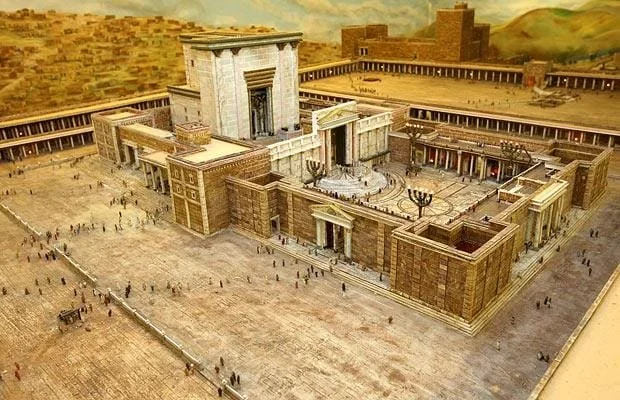
Saturday, December 6
Scripture: Mark 11:27-33
[27] Again they entered Jerusalem. As Jesus was walking through the Temple area, the
leading priests, the teachers of religious law, and the elders came up to him. [28] They
demanded, “By what authority are you doing all these things? Who gave you the right
to do them?
[29] “I’ll tell you by what authority I do these things if you answer one question,” Jesus
replied. [30] “Did John’s authority to baptize come from heaven, or was it merely human?
Answer me!”
[31] They talked it over among themselves. “If we say it was from heaven, he will ask
why we didn’t believe John. [32] But do we dare say it was merely human?” For they were
afraid of what the people would do, because everyone believed that John was a
prophet. [33] So they finally replied, “We don’t know.”
And Jesus responded, “Then I won’t tell you by what authority I do these things.”
Some thoughts
Jesus was Prophet, Priest, and King. One of the things prophets did was to proclaim the truth. Often that got them in hot water. In this case, this conversation took place during Holy Week. A little context will help us grasp the significance of this inter action with the religious leaders. Previously Jesus had cleansed the Temple of moneychangers. He had healed a blind man. He had forgiven people of their sins. The religious leaders came from three groups of people, the teachers (scribes), priests, and elders. They were the religious authorities. It is important to note this authority to interpret the Scriptures was given to very few persons. Such a status did not occur until the person was at least thirty years of age. Only the most brilliant ever attained this position. Typically, these persons had memorized the entire Old Testament. Jesus was perceived as such a person. Therefore, the religious leaders came at Jesus again and again demanding proof of His authority, particularly since it countered their interpretations.
This passage is another example of the conflict. In discussions among rabbis the normal pattern was to answer a question with another question. [That was the pattern here as well.] The question of the rabbi who responded to the initial question needed to demonstrate, not only an answer, but also a grasp of the implications of the first question. You see how insightful Jesus’ question was. He forced the religious leaders to confront the choice between a prophet speaking God’s truth from heaven (John) or simply view John as an ordinary man speaking human ideas. Public opinion was in favor of the former, John speaking God’s truth.
The leaders were unwilling to believe John because it would destroy their position and they would have to acknowledge Jesus was the Messiah. They were also unwilling to go against public opinion, which would expose them as religious bigots. So, they refused to answer Jesus’ question. Jesus followed with a parable in which He further exposed their hypocrisy. Do you look at these religious leaders as hard-hearted people protecting their position by refusing to acknowledge the Lordship of Christ? How often does the authority of Jesus in your life cause you conflict? (Just following the rabbi’s pattern!) If the Lord always agrees with you, you are in trouble!
Prayer:
O Lord, let me not henceforth desire health or life, except to spend them for Thee, with Thee, and in Thee. Thou alone knowest what is good for me; do, therefore, what seemeth Thee best. Give to me, or take from me; conform my will to Thine; and grant that, with humble and perfect submission, and in holy confidence, I may receive the orders of Thine eternal Providence; and may equally adore all that comes to me from Thee; through Jesus Christ our Lord. Amen.—Blaise Pascal (1623-1662)

Friday, December 5
Scripture: Jeremiah 1:4-10
[4] The LORD gave me this message:
[5] “I knew you before I formed you in your mother’s womb.
Before you were born I set you apart
and appointed you as my prophet to the nations.”
[6] “O Sovereign LORD,” I said, “I can’t speak for you! I’m too young!”
[7] The LORD replied, “Don’t say, ‘I’m too young,’ for you must go wherever I send you
and say whatever I tell you. [8] And don’t be afraid of the people, for I will be with you
and will protect you. I, the LORD, have spoken!” [9] Then the LORD reached out and
touched my mouth and said,
“Look, I have put my words in your mouth!
[10] Today I appoint you to stand up
against nations and kingdoms.
Some you must uproot and tear down,
destroy and overthrow.
Others you must build up
and plant.”
Some thoughts:
Jeremiah was an Old Testament prophet writing around 600 BC. This book opens with a very interesting passage, particularly considering some of the issues in today’s very secular societies. What stands out immediately is that God knew Jeremiah before He formed him in his mother’s womb. In the same manner, God knew you and me before He formed us in our mother’s wombs; in fact, He chose us before the foundation of the world (Ephesians 1:4). We get a clear idea that God knows all about us even before we existed, and it makes sense that the One who made us knows us best and has a purpose for our life. Indeed, our life began at conception in our mother’s womb as she was the first one who housed, who made a home for our little life! A closed -minded secular culture turns a willful blind eye to address this monumental truth (Isaiah 49 :1).
In Jeremiah’s case, his vocation had already been determined. Like Abraham, Moses, and Daniel, Jeremiah complained that he couldn’t speak for God. He objected to God’s call believing he was too young. He needed to hear Paul’s words to Timothy (I Timothy 4:12). Like Isaiah, God touched Jeremiah’s lips giving him words to speak. God vowed His presence and His protection. Jeremiah needn’t be afraid of the people. Time and time again, God delivered him from dangerous situations, though his life had a great deal of suffering. The book is filled with many heartfelt conversations with God revealing Jeremiah’s intimate relationship with his God. Tradition has that he was eventually stoned to death in Egypt by his own people, Jewish exiles who rejected his message.
To what task has God called you today? I’m not sure how often we remind ourselves of our part in God’s bigger unfolding of history. Whether we are out in the wide-open prairies of Kansas or in the bustling streets of Hong Kong, my guess is that most of us feel pretty insignificant in what God is doing in His Kingdom today. What difference do I really make? Is my life important, or am I just another of the billions of people on this planet for whom God cares? Such thinking is really another version of Jeremiah’s “I can’t speak for You, Lord. I’m too inconsequential in Your grand design for the world.” Not true. It’s a lie. God’s Word to you and me is the same Word He gave to Jeremiah. “I will be with you, and guide you, and give you the Words to say. Don’t make excuses and sink into your own little world. I have a purpose for you being on earth! I love you. I sent My Son to be the Saving Messiah for you. Don’t belittle Me and My precious gift with such thoughts.” Friends, the Lord knows all the details of your day. What is God saying to you in this passage concerning today? Take courage, hold still, and listen. God still accomplishes His will through very ordinary people like you and me. We may not find our names in the Bible, but we are in God’s history of the world book.
Prayer:
Father in heaven, I find it so easy to live each day focusing on the things of the day, things I must do, work, errands, bills, checking the news… Even when I read Your Word, too often it is more like another check in the to -do list for the day. In truth, though it’s embarrassing, sometimes I forget what I’ve read right after I read it. My mind is elsewhere. The intimacy of Your Words “I knew you before I formed you in your mother’s womb” is haunting. That familiarity goes deeper than any relationship I’ve ever known. Forgive me for brushing off Your desire to lead and guide me in the path you’ve prepared, a path of eternal significance. I repent of the dullness of my mind and will. When I read Your Words, help me hold still until I hear Your voice and find Your mind in what You have to say to me. Help me revel in Your presence, This I pray through Jesus Christ, who with You and the Holy Spirit, reign One God, world without end. Amen.